Pretty Poison was billed as a teen exploitation flick but plays like a bad thriller—the kind that’s actually kind of fun. It's one of those movies that makes you wonder whether its comic effect is intentional, given how seriously everyone involved seems to be taking it. The story of a troubled young man (played by Anthony “Troubled Young Man” Perkins) who gets involved with a color-guard high school blond (played by Tuesday Weld, whose name sounds like a to-do list at a shipyard—Monday: Rivets. Tuesday: Weld) includes badly planned espionage, heavy handed dialog, tragic-yet-unexplained psychotic pasts, and inappropriate romance. At its opening, we and Tony are warned that fantasies can be dangerous in the real world; he's going out on his own now, away from this “facility,” and he'd better stop with all that imagination stuff.
Well, he doesn't. He also breaks his probation (from his not-jail) for no other apparent reason than to work at a chemical plant instead of the lumber yard, where the dumping of bright red waste into a river fixates him like so much blood. He also fixates on the high school color guard, and Tuesday in particular, to whom he spontaneously presents himself as a CIA agent. The bored little girl believes him, and the two embark on the most inept juvenile crime spree ever. Tony's a great CIA agent until Tuesday's belief in him leads to the discovery that she's even more insane than he is. He makes up stories; she brings them to life, leaving Tony completely paralyzed.
Psychologically, the movie makes no sense. We never really figure out what's wrong with this guy, or even really why we're supposed to believe there is something wrong with him. And the instant metamorphosis from blond cheerleader to raging psychobitch likewise goes unexplained. In fact, the main characters' every action seems inexplicable.
All the same, there is a certain entertainment value. The director's lack of subtlety can be somewhat humorous, and Perkins is always good as the seemingly unwilling and confused baddie. But unlike Psycho, his confusion here is due to sheer ineptitude rather than Norman's split personality. Couldn't we at least have had some men pretending to be doctors explain everything he did in an anti-climactic denouement? Perkins had the unfortunately ability to project adorable psychotic confusion, which got him typecast in crap like this. Unlike the muddy waters of the film's psychological state, however, the lesson is clear: imaginative, intelligent, inept young men are always screwed over by pretty young girls with ambition. Remember, boys: “The world has no place for fantasies.”
Read more!
Monday, November 27, 2006


Wild in the Streets (1968) and GAS-S-S-S (1970)
In the late 1960’s, small-time studio American International Pictures became notorious for their exploitation pictures; movies that appealed to the new “youth culture.” Two such, Wild in the Streets and GAS-S-S-S, are included on an MGM “Midnite Movies” DVD release, and despite similar subject matter the juxtaposition displays very different attitudes towards the films’ audience.
Wild in the Streets, the more famous of the two, was made in 1968 and adapted from a short story in which 15-year-olds win the right to vote, vote “old age” out of power, and end up electing a 25-year-old rock star president. 30 means mandatory retirement; 35 internment at LSD concentration camps. The movie is billed as a satire aimed at youngsters; a sort of fantasy in which the newly mobilized young get power. The poster boasts Jim Morrison’s exhortation that “we want the world and we want it now,” and the reputation the film has is as a youth cry to arms.
Watching it, though, reveals a hateful attitudes towards youth that runs contrary to any rebellious image I previously had of the film. The “kids” are ineffectual, write really bad music, and are unable to govern themselves. Youth-in-power doesn’t result in an American utopia but a fascist nightmare. Adults may be opportunistic and ridiculous, but the new wave just seems stupid and unfocused. Their platform has one plank: since the marketing whizzes say the under 25 crowd makes up 52% of the population, we’re the majority. Once held, this majority does nothing but smoke pot, put LSD in the water, and deploy their might to keep adults corralled in acid-flooded camps that have nothing of the groovy communal about them. President Max Frost doesn’t seem to learn anything either, or benefit from his ascendancy; and the end of the film predicts a bitter reprisal.
In sum, this film is a mockery, a sadistic fantasy, of the youth movement’s desires for political voice.
The antidote to this bad-acid trip is on the other side of this disc: the delightful, pop-culture rich, Roger Corman-directed GAS-S-S-S (1970). In a similar scenario, all adults over 25 are simultaneously wiped out by a freak accident, leaving the youngsters to fend for themselves. The premise occurs right at the beginning, without the wading through nonsensical exposition Wild requires. A band of long-hairs travels across the newly-depleted American landscape, encountering exactly what you’d expect if half the population had been wiped out—small bands of power-hungry survivors, just trying to get by. Of course each group represents a different manifestation of power, be it communal, fascist, or just plain thievin’. But at no point does the movie contend that it’s the youth themselves causing the mayhem. This is the system they inherited, and with no law and order and society would break down.
The script is rife with gags of varying degrees of cleverness and crammed full of cultural references. On top of that, it’s just absurdly fun. A shoot out in a junkyard (shades of The Chase?) involves hurling the names of Western stars at each other. Our hero finally deploys “John Wayne,” but regrets it later. “Maybe I coulda winged him with a ‘Clint Eastwood,’” he muses. Edgar Allen Poe shows up on a motorcycle to dispense doom-filled wisdom, proto-goth Leonore riding bitch. One very pregnant character has a bizarre-yet-contagious fixation on “the golden oldies” that supersedes all other thought of survival. (“I can’t bring a child into this world,” she eventually decides, and so remains pregnant.) Fascist loot-and-pillage gangs are run like football teams, complete with cheerleaders, uniforms, and marching band.
While its satire is less barbed (the ending, especially, is rather hopeful and hippie-friendly), GAS-S-S-S is actually a much more rational response to the youth-power sentiments of the time, not to mention a much more appropriate candidate for cultdom. For one thing, it’s a better movie (with far better music, provided by Country Joe and the Fish, than the rock-star-oriented Wild gives us). For another, it doesn’t crudely insult the very demographic it’s marketed for. Wild in the Streets doesn’t live up to its title. GAS-S-S-S, luckily, outstrips its own. Read more!
Borat (2006)
While press, and box office, for Borat has been very good so far, there are critics (and people who don't get paid for their opinions) out there who call the movie offensive, anti-semitic, and (un)humorous at the expense of people who are tricked into exposing themselves as bigots by an ostensible idiot reporting for Kazahkstan.
I have to say that those people really don't get it.
Borat, if you don't know already, is the creation of Sacha Baron Cohen; previously introduced on his HBO series Da Ali G Show. A bigoted, sexist, racist bumpkin, Borat interviews real people in America about issues such as homosexuality, slavery, manners, women drivers, and especially Jews. Baron Cohen has perfected his act to such an degree that by the time his target figures out something's up, it's too late; the release has been signed, the damning comments made. So it's understandable that people who've been caught on tape, and aired across the country, as espousing anti-Muslim, anti-gay views feel betrayed.
But this film's primary target isn't the people Borat ambushes, or even America as a whole. The feminists Borat offends don't come off as idiots. The black kids he meets on the street do their best to help a hapless white guy who wants to figure out their culture. The southern dinner party guests deal kindly with the ignorant sot until he hands his hostess a bag of feces and invites a prostitute over as his date. Even his overweight cohort, though displayed rolling around naked for about ten minutes, comes off mostly as a really good sport.
No, what Borat does is make his audience extremely uncomfortable by confronting us with some unpleasant truths about what we're willing to put up with. These people aren't so much set up and shot down as damned for not doing anything at all. When Borat goes into a store and asks what kind of gun is best for shooting Jews, shouldn't the owner call him on that? When Borat expresses disbelief in the concept of women having their choice whether to engage in sexual activity or not, shouldn't that elicit more than an uncomfortable chuckle?
To my mind, what Baron Cohen does is not in itself racist, sexist, or even anti-American. It's less about what he says and more about the reaction he gets (or doesn't) from the regular people he encounters. For me, this reaction is most clearly encapsulated in two reactions: one from the dinner party guests who, with Borat out of the room, tell each other he's just a little uneducated and shouldn't be long in assimilating; and when the owner of a rodeo tells him he should shave off his mustache to look less “like them.” One could argue that the betrayal felt by these people is a lesson in giving the “other” the benefit of the doubt, but I would argue that it's still an illustration of treating people who don't sound or act like us as something alien.
In the end, though, what's really impressive about this film is its relentlessly upsetting comedy. It bludgeons you with Borat's adventures, made all the more mind-boggling by the mental somersaults you're forced to do to decide what's a “real” encounter and what must be a set-up. To his credit, Baron Cohen seems to have improv'd most of the film, and his ability to stay in character is tremendous. I don't know what he'll do now that he's been irrevocably exposed, but Borat the movie is a hilarious, offensive, and weirdly informative look at the American hunger for media. Read more!
Friday, October 13, 2006
Jesus Camp (2006) and Soldiers in the Army of God (2000)
At Devil’s Lake, North Dakota, there is a summer bible camp called "Kids on Fire". Children's pastor Becky Fischer leads evangelically-minded children towards a better understanding of God's plan for them, and their duty to Him. This film, shot on a very small budget, follows some of these kids from home to camp to an anti-abortion protest in Washington. And it's extremely disturbing.
I'm always very careful when viewing (and reviewing) documentaries that reinforce my own beliefs. I try to remain suspicious of films where, for example, I go in thinking so-and-so's a nut and then the film portrays them as, well, a nut. So I was skeptical of some of the editing here, until I realized something: Becky Fischer has seen this footage. There is footage of her watching this very documentary--children speaking in tongues and admitting their sins and crying about aborted fetuses--with a huge grin on her face. She knows this is going to bother me, and she's happy about it.
In other words, it's possible to over-apologize for bias.
So I feel justified in saying that the treatment of children in this film sickens me. Over and over we are confronted with images of eight, nine, ten year old children being told not to think for themselves, to be obedient to God's (or, at a pinch, your pastor's) will, and to repent of their many sins. They are led in militaristic dances intended to arouse passion. They parrot rhetoric against "dead churches," the kind where you just sit and pray and don't raise your voice to God. They literally worship a cardboard cutout of George W. Bush. They are shown eraser-sized replicas of babies, told that these represent the friends they never had because they were aborted, and submit to having red tape slapped over their mouths as a symbol of protest.
Eight. Nine. Ten years old. Ten year olds do not need to repent of their sins. Eight year old girls do not need to know about abortion. What's amazing about this film is the obvious intelligence and agency of these children and the use to which it's being put. Levi and Heather, especially, are fantastic kids. And they are being shaped, with very little subtlety, into the next generation of preachers and politicians. And while I believe that some of this indoctrination is done "for their own good" in their families' eyes, the film also betrays a sense of mercenary zeal to get these kids on the right side of what the adults think is a war. In the end, though, the movie answered very few of my questions and left me merely outraged and confused. What is behind it? What do they want? What is their reasoning, and how can Fischer place W on the dais and then protest that she is not pushing politics on her kids?
A good companion to this movie is Soldiers in the Army of God, an HBO documentary from 2000 (available on DVD) which follows several known religiously-motivated anti-abortionists in their activities and includes interviews with a convicted murderer of abortion providers. While I certainly came away with a perception of lots of crazy going on in the world, the people themselves were given ample time to explain their views, their actions, and their politics. I understand a lot more about their justification for their actions, and I feel that the radical anti-abortionists portrayed were treated fairly. For me, it was a window onto something I do not understand; much as I hoped Jesus Camp would be. I am by no means equating politically active religious folks with murders—but there are parallels in the films, and they are useful when viewed in conjunction. If you do see the DVD, I recommend reading the original Esquire article and watching the follow-up interview with O'Toole in the bonus features, as they shed even more light on the subject.
The question of religion in this country (the U.S.) is becoming increasingly fraught with complications. While it is doubtful that anything will make the two sides see eye to eye (one mother in Jesus Camp sees the world as "people who love Jesus and people who don't"), it is good to have unbiased filmmakers attempting to inform the public of the conflict's background. Read more!
Friday, September 29, 2006
The Black Dahlia (2006)
My relationship with Brian De Palma, though his films anyway, is a complicated one. So when every critic paid for the job can’t accept that the man who gave us Scarface can’t do better than Black Dahlia, I’m asking why the man who gave us Greetings, Phantom of the Paradise and Carrie can’t do better than The Untouchables.
For my money, he finally has; and with Black Dahlia. Adapted from James Ellroy’s novel, Dahlia puts De Palma through his voyeuristic, campy paces in a way people who wanted another L.A. Confidential (and honestly, who doesn’t?) weren’t expecting. I know I wasn’t. I expected to hate it. Josh Hartnett, who with Aaron Eckhart makes this movie the Battle of the Beady Eyes, as star? Hilary Swank as femme fatale?
The critics’ opinion is that this film is disjointed; that it doesn’t know what it is; that it’s incoherent, laughable, campy, and a big disappointment. Haven’t watched a lot of De Palma over the past year or so, I have to wonder what they’re expecting. I never liked the director until I realized that he’s laughing the whole way. Body Double? Repulsive unless you read it as a dark comedy.
Maybe I should back up and talk about the film a little. Okay. Hartnett is Officer Dwight "Bucky" Bleichert, who teams up with Sergeant Lee Blanchard (Eckhart) to share Blanchard’s girl Kay (Scarlett Johansson with ridiculous hair) and the discovery of Elizabeth Short’s mutilated body. There are lots of plots and subplots relating to this tenuous threesome, Blanchard and Bleichert’s somewhat political rise through the ranks, and Blanchard’s rising-yet-hidden obsession with the Black Dahlia murder. Eventually Bucky takes over, his cool reserve boiling over when he gets embroiled in a bizarre family drama involving the Linscotts. It’s the dinner scene where Hilary Swank as the Linscott daughter brings Bucky home and all domestic hell breaks loose that I realized I couldn’t not like this film. This scene is worth the price of admission. It’s hilarious. And I was amused enough to just go with everything else we’re supposed to believe, without trying too hard.
Because yes, it’s convoluted. And you have to take a lot of tangled threads on trust. Do I really think they’ve solved the Dahlia murder? No. It’s ridiculous and the film really falls apart in trying to explain it. I still don’t really understand what they were going for here; but it looks great. De Palma tends to surround himself with people he can trust, and his crew here has many familiar names who do him proud. Not to mention an underused Bill Finley, star of many early De Palma films who appears here as something of an homage to Phantom of the Paradise. There are some other problems as well, such as a plot point that hinges on two people looking alike who really don’t.
A great deal of one’s opinion is based on what’s expected. I think there’s an idea of De Palma at work here that for me was never true; I like this movie because I like De Palma’s roots and I desperately want him to go back to doing comedy. I’m not looking for a retread of the 80’s, when I disliked most of his films. De Palma’s darkness makes you uncertain about his humor; he’s a lot easier to watch if you pick up on the funny. After all, a guy who casts himself as the off-screen director of Betty Short’s screen test, questioning her ability to portray sadness, has to be pretty funny.
The Black Dahlia isn’t a comedy by any means, but I think anyone who goes in expecting something dreadfully serious and “straight” is going to be disappointed. For myself, I had fun. It’s up to the viewer whether that’s good enough or not. Read more!
Monday, September 04, 2006
Rosemary's Baby (1968)
Rosemary’s Baby (1968)
I don’t watch a lot of the kind of movie typically deemed “horror,” mostly because slasher stuff doesn’t gross me out enough to scare me. What’s hidden, however, could very well exist without my knowing it, and is that much scarier. I think that’s why Rosemary’s Baby holds up so well nearly 30 years later; it’s about anxiety and marriage and urban life and childbirth, not about freaks with chainsaws.
The strength of this film is that it asks you to believe one thing—that a cabal of Satanists could impregnate a woman with the son of the Devil—and leaves everything else really really normal. The problem for me with Exorcist-style films (right now I’m recalling with horror of a different kind the recent The Exorcism of Emily Rose) is that they pose what looks like a similar situation but requires constant suspension of disbelief. Here, we have one single act, and some suspicious behavior, and Rosemary’s fear and anxiety are our own.
Of course, it’s to Roman Polanski’s credit that he is a good director to begin with and can carry such a concept in a film with naturalistic dialogue, pedestrian settings and some unusual transitions from scene to scene. It recalls that old debate over genre-films—can “horror” or “scifi” be also “good,” or does a good film by definition transcend genre (leaving those nether-regions to be populated by the B-pictures)?
The actors, also, do a fantastic job. Mia Farrow has to propel everything pretty much on her own, and she succeeds in portraying an intelligent (though tiny) woman who, for whatever reason, is underutilized in the life she’s living. Rosemary needs something to do. The film is just as much about her struggle with unfulfillment and boredom as her painful pregnancy. And isn’t her pregnancy as much about the plight of the married woman who discovers just what her “job” entails as about the devilchild?
If it sounds like I’m making this film out to be just a meditation on the horrors of childbirth from a masculine point of view, I don’t think it’s that simple. But the significance of a conspiracy of older, powerful people holding sway over the lives of the younger and markedly more feminine can’t be denied. Which is why I think the film could have done away with the coda in which she meets the baby—not because I don’t like seeing her reaction, but because the commentary by the cabal is unnecessarily direct. “He has his father’s eyes,” is funny, sure, but there’s no need for a rousing cry of “Hail Satan!” It’s the ambiguity that cements this film in something like real life—hasn’t everyone felt insecure about what they’re bringing into this world?—and an ending more in keeping with that would have satisfied me better.
Up until the end of the film, Rosemary’s Baby plays on the very real horrors of the repressed urban housewife and anyone else who’s been in a remotely similar situation. It creates real dread with no manipulative fuss and some very creative dream sequences. A lot of horror doesn’t age well, because it’s tied to either immediate concerns that fade or are scientifically discounted (atomic power) or to the special effects that are constantly getting better (gore-fest films). It’s doubtful that Rosemary’s Baby will cause unintentional snickers from an audience thirty years from now. Read more!
Tuesday, August 22, 2006
C.S.A.: The Confederate States of America (2004)
So. Pretend you’re sitting down at home to watch the must-see British documentary of the year. It’s so controversial, you’re even willing to sit through the commercials. Now pretend you live, not in the United, but the Confederate States of America. And that the documentary is about the history of your great nation.
Oh, you should probably also assume you’re white.
Because this fake-doc is an exercise in alternate universe building. The South was able to convince France and England to come into the Civil War on their side. The Confederacy won. Lincoln went into hiding, Davis became prez, the North was re-introduced to slavery, and Canada became the cultural hotspot of the western world. Leaving lots of really bad actors to play in this doc’s recreation of history, it must be said.
This fascinating idea is presented complete with commercials whose offensiveness rises with each break. Think Aunt Jemima times a million. In between a fake history of subjugation, false science, non-suffrage for women, and the inevitability of the Kennedy assassination in any timeline, we are introduced to a vision of what it would be like to live in this world. Advertising extrapolated from actual products and campaigns now deemed too politically incorrect to even mention. (If you saw Ghost World, you have a clue as to the kind of thing I’m talking about.) And that’s not even including the rampant blackface employed.
This is a tricky film, because there’s a fine line between laughing uncomfortably and turning something off. For my part, I was laughing, and then I was staring open-mouthed, and then I was frantically trying to work out how I felt about their version of history and if it jibed with what I’d extrapolate from their initial premise. Not all of it rings accurate for me, and the film would have been much better served by acting that made me believe the clips of “historical films” and commercials were actually real. But its treatment of racial issues is bold in the extreme, even if, in the end, all you’ve really learned is how offensive this country can be. Some may argue that the film is too offensive itself and be made uncomfortable by the (satirically intended) humorous take on slavery; but it’s also a confrontation with our dark history, and a valiant piece of work. Read more!
A Boy and His Dog (1975)
In 1975, someone decided to anticipate The Road Warrior with Don Johnson (nine years pre-Miami Vice) as a really horny Mel Gibson (which, honestly, I guess he is) and a telepathic sheepdog named Blood standing in for Max’s “Dog.”
Yes. It’s a movie about Don Johnson and a talking dog wandering around the desert looking for sex. And popcorn. Based on a story by Harlan Ellison. And everything you can anticipate about this, good and bad, is probably true. With a premise like this, I almost don’t need to write a review.
This is bad filmmaking at its finest; the kind that really needs to be seen to be believed, and yet is also highly entertaining. The plot meanders, the acting lags, many of the concepts and plot points are unseen, unexplained, or inexplicable (there is a society of people living underground in “Topeka” who march around with a band and wear face paint all day) but there is so much unexpected weirdness that it makes up for everything else. And it’s got just about the best ending you can hope for.
In the end, what’s wrong with this film isn’t so much its budget, or Don Johnson, or talking dogs. I can’t even say that the filmmakers wussed out. They don’t pull their punches, it’s true; but they don’t aim at enough for me to consider this film truly brilliant. This wasteland could have been filled with absurdist satire, rather than sprinkled on top of a rather bland post-nuke landscape; a line like “We could have used her three more times!” needs to be followed up with something more than half an hour of “I’m hungry/horny.” At the same time, though…
There’s a talking dog. And Don Johnson. Read more!
Saturday, August 19, 2006
The Last Picture Show (1971)
A few days ago I reviewed Bogdanovich’s Targets, my effusiveness knowing no bounds. You might very well ask why I neglected The Last Picture Show in that review, as it’s clearly the Masterpiece, the work by which all subsequent offerings from Mr. B have suffered.
The answer is: because everyone already knows this.
I loved The Last Picture Show. I loved Sam, and the subtle ways in which the characters revealed themselves over the course of the film, and the cinematography, the lighting, the script, the acting can’t be faulted. Which doesn’t make for a very fun review, does it? The Last Picture Show is so good at what it does, so thorough at what it says, that there doesn’t seem to be anything left to say. I could point out that Texas is really boring, or that the sex isn’t very good but they ain’t got nothin’ else to do, or that Jacy’s going to end up just like her mama, but it’s already been said.
But for those of you who haven’t seen it: Bogdanovich and Larry McMurtry, with the help of Cybill Shepherd, Timothy Bottoms, Jeff Bridges, Cloris Leachman, Ellen Burstyn and Ben Johnson created a searingly dusty portrait of small-town life in the 1950’s. The kind of place where everyone knows what’s going on but no one talks about it, and where escape is illusory because it’s only possible in adultery, the movies, or the military. It’s a perfectly recreated little world, and displays the talents of all involved to their best advantage. It’s also a monument to failure, in that many of the people involved—and the director most of all—never achieved this kind of grace again. Read more!
Thursday, August 17, 2006
Death Race 2000 (1975)
I am appalled. There is a movie out there which depicts, in gory B-movie detail, five contestants’ trans-continental race in which the object is to hit as many pedestrians as possible, babies and codgers being worth the most. Women are naked and the value of human life is ruthlessly dismissed.
And I’d never seen it before.
I think the brilliance of this movie is contained in the tongue-in-cheek attitude of it being played almost totally straight. No one’s winking, except maybe Sylvester Stallone, who does a show-stealing turn as an uncouth Chicago gangster stereotype that is so committed you have to love it. Even though I still don’t believe that David Carradine could take him.
The raunchy humor is decidedly dark, as when one driver’s attempts at a three point turn bring her unknowingly ever-closer to a hidden land mine; or when Nero the Hero’s navigator, while directing him towards a picnic, instructs him “if they scatter, go for the baby and the mother”; or when the nurses and doctors of a rest-home facility wheel their contended charges out into the street for “euthanasia day.” This violent attitude is embraced so playfully by the film that it goes beyond gratuity to hilarious. There are so many great quotes I could go on forever, and it’s all wrapped neatly in a low-budget but never shoddy package which includes some very attractive women whose assets are not wasted. And some of the humor is actually kind of witty.
If you have any sense of humor at all, you’ve probably seen it already. But in case you’ve been living in a cave like I have, you have to see this movie.
Unless stuff like this:
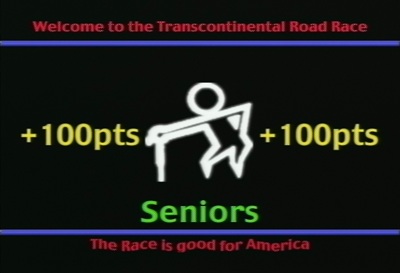
offends you. Read more!
And I’d never seen it before.
I think the brilliance of this movie is contained in the tongue-in-cheek attitude of it being played almost totally straight. No one’s winking, except maybe Sylvester Stallone, who does a show-stealing turn as an uncouth Chicago gangster stereotype that is so committed you have to love it. Even though I still don’t believe that David Carradine could take him.
The raunchy humor is decidedly dark, as when one driver’s attempts at a three point turn bring her unknowingly ever-closer to a hidden land mine; or when Nero the Hero’s navigator, while directing him towards a picnic, instructs him “if they scatter, go for the baby and the mother”; or when the nurses and doctors of a rest-home facility wheel their contended charges out into the street for “euthanasia day.” This violent attitude is embraced so playfully by the film that it goes beyond gratuity to hilarious. There are so many great quotes I could go on forever, and it’s all wrapped neatly in a low-budget but never shoddy package which includes some very attractive women whose assets are not wasted. And some of the humor is actually kind of witty.
If you have any sense of humor at all, you’ve probably seen it already. But in case you’ve been living in a cave like I have, you have to see this movie.
Unless stuff like this:
offends you. Read more!
The Untouchables (1987)
When Brian De Palma makes a movie, you’ll frequently see it advertised as “from the director of Scarface and The Untouchables.” This is because lots of people think these are his best/most popular movies. And yes, they’re slick, and pretty, and lots of money was spent. But The Untouchables is just about the coldest gangster movie I’ve ever seen. I can’t think of a movie I cared less about the characters in. The bloody, operatic death of a respected or liked character is moving. The bloody, operatic death of a fictional person I don’t care about is, well, just bloody.
You’d think this would be a fairly common complaint, given the team-up of De Palma with scriptwriter David Mamet. I mean, combine the two and you’re pretty much asking for humanoid robot aliens. Don’t get me wrong, I love De Palma—but I like him more when I’m not being asked to like people. Or when, as in his early work, I actually liked his people anyway.
Although the people here should be likable enough. Kevin Costner is still Kevin Costner, but he looks the part. Sean Connery is an Irish cop, but with the worst Irish accent ever. Not that it’s his fault. Asking Connery to replace his lispy brogue with anything is like asking Costner to emote; he’ll do it, but you certainly don’t want to watch. And it’s a very small problem in relation to the character as a whole. For instance, Ness asks him why, if he knows all about bringing down Capone, he’s still a beat cop? And we never find out. Also, he’s a racist. The lousy mick can’t tell the difference between a dago and a wop. Speaking of which, Andy Garcia does a great job as the only Italian in Chicago who’s not a gangster. And you’ll get a glimpse of an early Patricia Clarkson role as Ness’ wife.
But the things these actors are asked to do would stymie anyone. Connery and Costner have a meet-cute when Costner is caught littering. Conversations start with lines like, “Yes, I heard about it.” Connery has to say stuff like “It smells worse than a whorehouse at low tide” and “Here’s your warrant!” PUNCH. Costner, after two hours of bloody carnage, mutters “so much violence.” De Palma juxtaposes little girls praying with Capone bashing skulls in, as if to remind us of the horrible dichotomy of the world we live in. Then he shoots action scenes like horror movies, that don’t even get my adrenaline going enough to be aroused by the violence. Then there’s the famous Battleship Potemkin rip-off, with the baby carriage and all that. To my mind, appropriating a scene from another film in order to make something new of it is one thing. De Palma’s done this before, and brilliantly. But copying something without commentary or addition is just copying, unless you’re in Hollywood, and then it’s homage. Or proof you went to film school.
In the end, this movie’s pretty, with some good soundtrack moments by Ennio Morricone, but it’s not pretty enough for me not to care that I don’t care about anyone in it. I could make a really bad joke playing on appropriateness of the film’s title considering how I feel about it, but what’s t he point? Read more!
Targets (1968)
Where did Peter Bogdanovich go? These days, he comes across as a pretentious movie-geek guy who talks about other peoples’ movies and left his talented wife for Cybill Shepherd. But you know what? He used to make really good movies. Like Targets
You thought I was going to say The Last Picture Show, didn’t you?
Targets was made for Roger Corman with the stipulation that footage from an old Boris Karloff movie had to be used and Boris Karloff had to be in it for the two contracted days he owed Corman. The movie is in fact about an unmotivated shooting spree. Patching these two things together could have been a disaster. What happened instead was a weirdly affecting look at horror in the movies and in life.
Half the story involves “Byron Orlok,” an old-time horror movie star, making a break for retirement while Peter Bogdanovich tries to get him to read a script and falls asleep drunk in his bed. Yes, Bogdanovich cast himself as a director attempting to persuade Boris Karloff to make a film about “the real horror.” I wonder what the script was called? His cinematic enthusiasm is not yet jaded however, and despite the fact he appeared to only require one take from himself, his presence is amusing.
The other plotline follows Bobby Thompson as he procures lots of guns, sits in the dark a lot, and plays with us by aiming at various people with loaded weapons. This is the heart of the movie; the slow descent of a man who is about to snap for no discernable reason. The suspense ratchets up because you know this guy’s going to do something horrible, and yet no one around him can see it. This is admirably accomplished without the use of non-diegetic music. We are left with the sounds that surround him every day; the television, the radio, the news. The lighting, likewise, is very natural. In a dark room, it is dark. Ambient light has a logical source. Cigarettes glow but faces are obscured except when a passing headlight signals the wife’s return. And what will a man with a rifle who smokes in a dark room do when she gets home?
The two parties meet up at a drive in, where we are inundated with Bogdanovich’s adoration for the cinema as well as treated to a climactic finish which explicitly places movies as both cause and solution for violence. All of it is filmed with such care and intelligence that it seems preposterous that movies should have to cost so much these days when intelligent thrills can be dished out on a low budget.
Because the movie does not try to explain Bobby’s behavior, merely recreate the trajectory of this personality in such a way that you can nearly understand it, the movie feels much more insightful than one would expect from something classified as a “B picture.” In the end, Bobby kills because he’s an excellent marksman, and people are the only targets who make the news. This, as Karloff and Bogdanovich discuss, is the real horror. Read more!
Sunday, July 23, 2006
Leonard Cohen: I'm Your Man (2006)
There are very few movies that I would unequivocally deter anyone from seeing. Rarely do I consider “crap” to be utterly useless. However, in the case of Leonard Cohen: I’m Your Man, I would advise staying as far away as possible if any of the following apply:
1. You love Leonard Cohen and/or his music
2. You don’t like butchered cover versions of his tunes
3. You hate Leonard Cohen and therefore have no reason to see this movie.
If this sounds harsh, let me lay out my argument concisely, since I have no desire to waste any more of my life talking about this than I have to. The film consists primarily of a tribute concert filmed a few years ago in Sydney. In the course of this concert, Rufus Wainwright, Jarvis Cocker, Nick Cave, and a bunch of people I’ve never heard of sequentially performed unrehearsed versions of Cohen songs while clearly reading the lyrics off a music stand. Some of them do a decent job (Rufus, particularly, but then he’s also sung these songs on his own albums, and some strange person named Antony has a wonderful voice) but others, like Jarvis, seem severely hampered by a backing band that has not had a chance to acclimate to the individual singers. Most disappointing, perhaps, is Nick Cave, as he is a clear acolyte of Cohen and ought to be able to pull off a decent cover.
The second most prevalent sort of material here is quotes from Wainwright, Cave, and, of all people, Bono. We learn from them that Cohen’s a good songwriter and an influential one. Bono tells us that Cohen’s songs are capable of touching us at multiple stages of life! Rufus is high or something, and Cave is just boring.
The smallest amount of time is devoted to Cohen himself. Given that this was the reason I watched the film in the first place, the fact that the clips used in the trailer were nearly the sum total of what is used in the film itself was disappointing. I had intended to sit through the cover songs for the sake of the man’s own words, but they are pitifully few and very little insight or recollection is provided.
Leonard Cohen is the best songwriter that I know of, one of the only talents I know who simultaneously awakens both my creative spirit and my eternal envy. A film about him, or a tribute concert, are not misguided projects. But a collection of embarrassing performances, poorly-shot interview footage, and a coda involving Cohen lip-synching with U2 is an insult to the man. If you want to know about Cohen, read a book. If you want to hear some decent covers, listen to about half of I’m Your Fan. Most importantly, just dust off your copy of The Songs of Leonard Cohen, because it’s not going to get any better. Read more!
Saturday, July 08, 2006
A Scanner Darkly (2006)
Thus far, at least eight feature films have been made from stories by Philip K. Dick. Most of them retain very little of what has garnered Dick his devoted readership, and some, like Blade Runner (adapted from Do Androids Dream of Electric Sheep), have been more or less disowned by many fans. In many ways, A Scanner Darkly, based on a 1977 novel by the same name, was the most likely to satisfy readers. Directed by Richard Linklater (Waking Life), who has a demonstrated respect for Dick’s writing, and featuring a perfect performance by Robert Downy Jr as Barris, this could be just what PKD fans were waiting for.
It isn’t.
The novel, about an undercover narcotics agent who becomes a victim of the very “Substance D” he’s trying to trace, is a mind-fuck of impressive magnitude. Bob Arctor is Fred, and Fred is Bob Arctor, but it becomes clear as the book progresses and Bob gets further and further into his role that Fred, who is charged with surveillance of Bob’s house, isn’t aware that he’s watching himself. Peopled with eccentric druggies and their spot-on nonsense dialogue, it’s a memorable read.
It’s a memorable movie, too, and it’s obvious that Linklater’s both read the book and liked it. The rotoscoped animation style, using a process by which real performances are drawn over frame by frame, lends a drug-reality to the world of the film, in that objects seem to come unmoored from their backgrounds and hallucination blends seamlessly with the objective. The “scramble suit” Fred wears to hide his identity and described as a “vague blur” is rendered as a constantly-shifting amalgamation of men, women and children and would have been impossible without animation. The film retains some memorable conversations from the book, such as Bob and his friends attempting to determine what happened to the extra gears on Barris’ 18-speed bike, since they can only count 9. As a portrayal of the drug experience, it does a lot right.
But there’s something missing. The very real loss of perception one experiences from reading the book, and really getting inside Dick/Bob’s head, is not achieved. The plot must be streamlined to make it coherent, and along the way the disorientation so vital to the book’s success gets cut away. At the same time, I truly wonder if anyone who hasn’t read the book will actually get what the movie’s about. So the question becomes, who is this movie for?
The very successful job Robert Downy Jr does is indicative of how this movie could have gone. With this blocky type of animation, acting must either be really subtle and voice-oriented or over the top. Keanu Reeves and Winona Ryder are really good at being blank, but that’s not the same as subtle. Everything’s lost when you can’t discern anything from their monotonous delivery or their comic-book faces. Reeves is at his best hanging with his drug-buddies; as Fred, we get no sense of another personality fighting with Bob for supremacy. Perhaps with different casting, Linklater could have done more with the great start he had.
The film’s not a total write off—there are excellent elements, and it’s a great achievement. I wouldn’t warn anyone off seeing it. But if you’re a Dick fan, be prepared to realize the years it took to get this film out weren’t quite worth the wait. If you’re not, see the film for what it is, and please, please pick up one of his books on the way home. Read more!
Saturday, July 01, 2006
Peeping Tom (1960)
In 1960 audiences were revolted by a film of such shockingly voyeuristic violence that it created a media outrage. And later on that year, Psycho came out.
Although it’s fallen by the wayside in the fickle memory of the collective cinema, Peeping Tom is so much more modern and disturbing in its implications, and its implication of the audience, than Hitchcock’s contemporary film that it comes across as severely screwed up even now. Imagine being made to identify with Norman Bates for the entire film, knowing straight off he’s the murderer. Now imagine him holding the camera. And that there’s a psychological reason for his behavior that’s not a tacked-on psychiatrist-ex-machina.
I don’t want to completely identify Peeping Tom with Psycho, although I just have—I merely want to illustrate how much more effective the former is at evoking similar themes in a way which is still relevant. The color of the prints has aged poorly, and the psychology is extreme, but the major theme of a man whose demonic need to produce and record the effects of fear by killing women is central to much discussion that still goes on around the issue of watching in the cinema.
The plot is subtly constructed by a screenwriter who was a major figure in WWII code-breaking, and the care taken to reveal new, startling information is shown in the film’s lack of sensational “pow!” moments. Nothing ever jumps out at you. The killer is known from the start. Yet each new piece of information adds to our understanding, and indeed our sympathy, for the protagonist; even as we fervently hope Mark’s young, innocent tenant Helen (Anna Massey) will make it through alive.
Though concerned with a pathological peeping tom and the horrific murders his disorder drives him to, the film is really about the director as filmmaker and us, the audience, as accomplices. Michael Powell, the director, plays Mark’s father in old home footage, with young Mark played by Powell’s son. The layers of watching and being watched compound, as Mark watches Helen watching movies his father made of Mark as a child. Helen’s mother’s blindness adds another complication, as well as an innate distrust of someone who needs to see so deeply and often that he cannot leave the house without his camera. In the end, the negativity of critics may have been due as much to the equating of watching with pathology as to outraged morals. For whatever reason, it’s very unfortunate that this film has been largely ignored since then except by a few “movie brat” directors like Scorsese and De Palma.
Then again, De Palma might not have had a career if people had had access to this gem. Read more!
Subscribe to:
Posts (Atom)